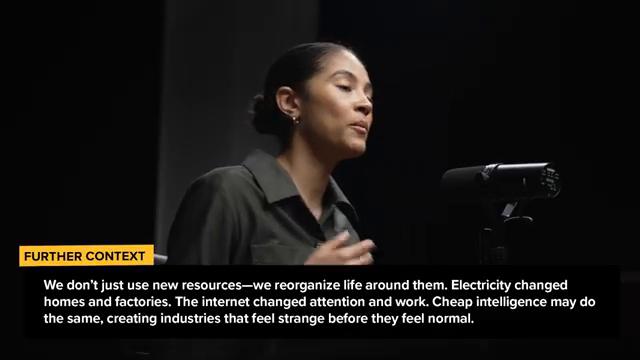
A.I. Futurist: What Your Life Looks Like In 2028


Channel: Mighty Pursuit
Uploaded by Mighty Pursuit on 20260526
Categories: People & Blogs
Tags: podcast, interview, mighty pursuit, mighty pursuit podcast, sinead bovell, a.i.
After a full year of being told AI was going to wipe out jobs, the collapse hasn’t happened. At least not yet. Unemployment hasn’t spiked. Most people still have their roles. On the surface, the economy looks familiar. And that creates a strange tension. You’ve heard the warnings. You’ve felt the fear. But now you may be wonderi

Here is a detailed breakdown of the content and themes discussed in the video "A.I. Futurist: What Your Life Looks Like In 2028" featuring futurist Chanakya (Chennai) Boll.

Overview of the Conversation

The podcast explores the disconnect between the massive AI hype of 2024–2025 and the apparent stability of the labor market in 2026. While widespread job collapses haven't yet materialized, Boll argues that


Image for chunk 1

we are looking at the wrong indicators. This period represents a "calm before the storm," masking a structural reorganization of how economic value is created, distributed, and rewarded over the next 3 to 10 years.

Key Themes and Insights

1. The Misreading of the Labor Market & The Transition Timeline

Short-Term vs. Long-Term Impacts: In the short term (under 3 years), the immediate threat of AI wiping out

Image for chunk 2

entire workforces is often overstated, heavily influenced by tech fundraising and marketing cycles [03:15]. However, over the long term (7 to 10 years), structural changes will mirror major economic shifts of the past.

The Scale of Change: To put the coming decade in context, Boll compares the timeline to historical transformations:

HISTORICAL LABOR SHIFTS (Timeline vs. Population Impact)

+---------------

Image for chunk 3

---------+-------------------+--------------------+

| Era / Event | Time Scale | Workforce Impact |

+------------------------+-------------------+--------------------+

| Industrial Revolution | ~100 Years | 70% shifted roles |

| Modern Era (Past 80y) | ~80 Years | 60% new jobs created|

| The AI Era Horizon | 10 - 20 Years | 70% role evolution |

+---------------

Image for chunk 4

---------+-------------------+--------------------+

Hidden Signals: While baseline employment statistics remain steady, hidden indicators reveal underlying shifts. Capital flows are quietly shifting away from easily disrupted sectors and moving toward "AI-resilient" incumbents and complementary assets like energy grid infrastructure and datacenter water filtration systems [17:12].

2. The Shift in Value: Ti

Image for chunk 5

me vs. Judgment

The Destruction of Arbitrage: Many knowledge workers currently use AI to shave 20–25 hours off their standard workweek while maintaining the same pay [23:51]. Boll warns that these arbitrage windows are temporary. Soon, employers will adjust expectations, setting AI-assisted output speed as the new default floor.

Repricing of Knowledge Work: Freelancers and agencies charging flat hourly rat

Image for chunk 6

es for easily automated tasks (e.g., standard coding drafts or basic copy) face heavy price deflation. Economic value will shift entirely from the execution of a task to the meta-cognitive skills underlying it:

VALUE RECONFIGURATION

[Old Paradigm: Time & Muscle/Cognition] ──> Hourly Execution of Tasks

[New

Image for chunk 7

Paradigm: Abundant "Intelligence"] ──> Human Discernment & Judgment

3. Human Cognition and "The Cognitive Divide"

Cognitive Atrophy and Debt: Over-reliance on AI for basic communication and information synthesis can lead to cognitive offloading. This can cause individuals to lose confidence in problem-solving and decision-making without a system validating their choice [36:25].

The Split Output: Boll iden

Image for chunk 8

tifies an emerging "cognitive divide" separating two distinct groups of users:

The Springboard Class: Those who treat AI as a launchpad to solve deeper, higher-order, and more complex computational problems.

The Outsource Class: Those who completely offload baseline thinking and judgment to the system out of convenience, diminishing their unique professional value.

4. Technical Realities: LLMs and the Arch

Image for chunk 9

itecture Plateau

Prediction vs. Reason: Large Language Models (LLMs) are next-token prediction engines optimized to sound right rather than be factually correct [43:14]. They simulate reasoning through highly sophisticated statistical pattern-matching but lack systemic world models or true contextual understanding.

The Coming Architecture Shift: Current Transformer-based models are approaching diminishing

Image for chunk 10

returns relative to the massive amounts of data and computing power thrown at them [56:50]. To cross the next major threshold of reliability and handle long-horizon tasks, the industry will require new synthetic architectures—such as neurosymbolic layers or advanced world simulators—to complement existing language models [58:12].

The Practical Roadmap: Navigating the Independent Era

Boll outlines a promine

Image for chunk 11

nt macro-trend: the gradual erosion of the traditional vertical 9-to-5 career ladder at a single company [27:00]. As business demands fluctuate rapidly alongside technological capabilities, companies will prefer agile contract-based arrangements over permanent roles.

Becoming an "Organization of One"

To remain resilient, professionals must transition from view-centric job titles to a deeply rooted bundle o

Image for chunk 12

f transferable skills.

THE INDEPENDENT SKILL MATRIX

┌────────────────────────────────────────────────────────┐

│ CORE TRANSCENDENT SKILLS │

├────────────────────────────────────────────────────────┤

│ • Meta-Cognitive Literacy (Understanding how you think)│

│ • Contextual Awareness & Data Discrimination │

│ • Adaptability & Self-Directed Learning │

│ •

Image for chunk 13

High-Fidelity Communication & Relational EQ │

│ • Trademark Judgment & Technical Sign-Off │

└────────────────────────────────────────────────────────┘

Advice to Individuals

Trace the Logic: When presenting work generated with AI assistance, always be ready to articulate the underlying trade-offs, reasoning trees, and exact logic that went into the final decision [14:03].

Maintain Agen

Image for chunk 14

cy: Avoid a mindset of total defeatism. A hopeless society yields its design space to the tech sector by default. The future isn't a fixed destination; it is an open framework continuously shaped by consumer choices, selective tool adoption, and local political engagement [01:22:17].

URL: https://www.youtube.com/watch?v=tBiO8A4tj9I

A.I. Futurist: What Your Life Looks Like In 2028

Mighty Pursuit · 125K view

Image for chunk 15

Viewer Discussion & Comments

@Tony-o2z7d
I'd argue that social media did replace us.. Most ppl would rather be on their phones or devices more than real life ppl - and it's getting worse.
@AnxiousBeagle
What people often ignore is that many jobs are fundamentally redundant, existing mainly to compensate for inefficiencies elsewhere in the system. Because everything is interconnected, making one part of the economy dramatically more efficient can eliminate entire categories of work in another.
@JoePiotti
It’s just like autonomous driving, it took longer to get to full replacement of a driver than anyone thought, but it is happening.
@NofOne2318
Pretty weird you're assuming we'd be seeing job loss already....agentic AI literally just came out. It's like if 6 months after the automobile was invented, you're like "look, everyone is still riding horses, they're here to stay!"
@oscarsalas1
Im a systems engineer and right now I feel just as a middle man between my company and Gemini/Claude lol, they could just literally connect all the datacenters to an AI and fix all the stuff automatically without human intervention