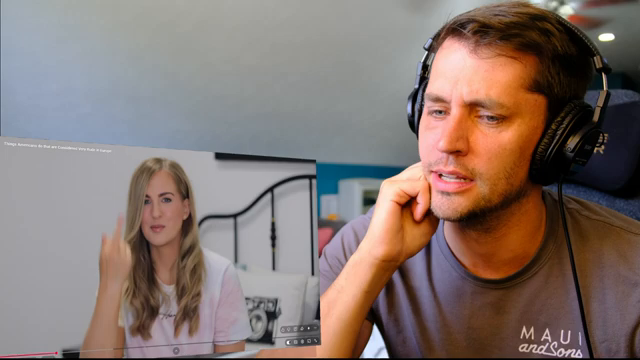
In this video, American creator Ryan Wuzer reacts to and comments on a video by Irish YouTuber Diane Jennings regarding American behaviors that are considered rude or unusual in Europe.
Overview of Topics & Reactions
1. Hand Gestures (Peace Si

In this video, American creator Ryan Wuzer reacts to and comments on a video by Irish YouTuber Diane Jennings regarding American behaviors that are considered rude or unusual in Europe.
Overview of Topics & Reactions
1. Hand Gestures (Peace Si
gn vs. Flipping Someone Off) [00:01:55]
Context: In Ireland and the UK, presenting the peace sign (two fingers) with the back of the hand facing outward is equivalent to flipping someone off.
Reaction: Ryan is surprised by how subtle the diffe

rence is between a peace sign (palm facing out) and an offensive gesture (back of hand facing out), expressing concern over how easily tourists could unintentionally offend someone.
2. Self-Promotion [00:05:07]
Context: Self-promotion is far l

ess common in Ireland/Europe, largely due to a cultural aversion to having "notions about oneself" (delusions of grandeur or acting superior).
Reaction: Ryan explains the cultural split within America regarding self-promotion and notes that he

personally dislikes promoting himself, despite having made videos for two decades.
3. Opening Gifts in Front of Others [00:12:40]
Context: Traditionally in Ireland, gifts at parties or weddings were not opened in front of the giver or guests
to avoid making anyone feel bad about differences in gift quality.
Reaction: Ryan highlights that opening presents in front of everyone is standard at American children's parties, though he acknowledges the rationale behind avoiding awkward co

mparison moments.
4. Circumcision [00:18:23]
Context: Routine infant circumcision is common in the United States, whereas in Europe it is rarely performed outside of specific religious or medical reasons.
Reaction: Ryan agrees that the practic

e can seem unusual when viewed from an outside perspective.
5. Taxi Seating Etiquette [00:21:10]
Context: In Ireland (particularly in countryside areas or daytime trips), solo passengers are expected to sit in the front passenger seat with the

driver; sitting in the back can be seen as antisocial or standoffish.
Reaction: Ryan points out that in the United States, sitting in the front passenger seat of a taxi or rideshare is usually discouraged or considered unusual/creepy.
6. Aski

ng for a "Doggy Bag" (Leftovers) [00:24:43]
Context: Requesting to wrap up leftover food to take home from a sit-down restaurant can be seen as "trashy" or improper in parts of Europe.
Reaction: Ryan expresses strong disbelief, arguing that ta

king food home avoids waste and that judging someone for taking their leftovers is unnecessary.
7. Speaking Loudly [00:30:14]
Context: Americans are often perceived in Europe as speaking at high volumes in public spaces.
Reaction: Ryan agrees

with the stereotype, admitting that many Americans speak loudly.
8. Punctuality & Driving Behaviors [00:31:10]
Punctuality: Ryan discusses arrival expectations in different settings, contrasting strict timekeeping in professional situations wi

th informal gatherings.
Driving Etiquette: [00:33:38] The video covers merging manners and acknowledging other drivers (e.g., a hand wave or nod when allowed into traffic). Ryan notes that traffic aggression in major U.S. cities contrasts with

the courtesy shown in smaller towns.
9. Asking for Condiments (Ketchup & Mayonnaise) [00:38:41]
Context: Asking for condiments like ketchup or mayonnaise at upscale European restaurants can be viewed as an insult to the chef's preparation.
Re

action: Ryan notes that while it might be inappropriate at a high-end restaurant, asking for condiments at casual establishments in America is completely standard.
American reacts to Americans things that are Considered Rude in Europe
Ryan Wuz

Viewer Discussion & Comments