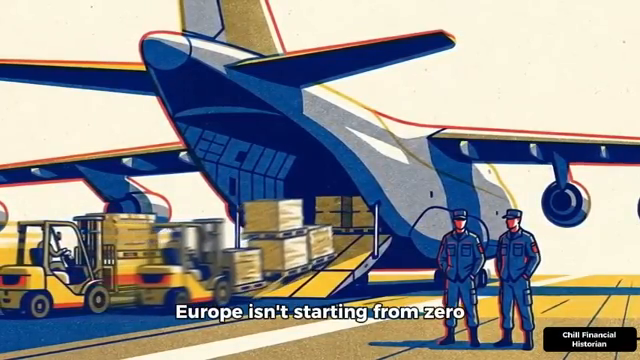
NATO 3.0: The Plan to Make Europe Defend Itself


Channel: Chill Financial Historian
Uploaded by Chill Financial Historian on 20260713
Categories: Howto & Style
Tags: NATO, NATO 3.0, European defense, NATO summit 2026, Ankara summit, NATO spending, 5 percent GDP, defense spending, Europe rearmament, ReArm Europe, Readiness 2030, Trump NATO, US troops Europe, burden sharing, Article 5, Russia threat, European army, transatlantic alliance, Hegseth, Elbridge Colby, Mark Rutte, Ukraine war, European security, Poland defense, Germany military, geopolitics, Bruegel, IISS, US troop withdrawal, NATO explained, strategic autonomy
NATO 3.0: The Plan to Make Europe Defend Itself. Exclusive Videos: https://www.youtube.com/channel/UCyPM2GKrhFnQG4o-YtEuCFg/join Spotify: https://dub.sh/cfhspotify Newsletter: https://dub.sh/chillfinancialhistorian X: https://x.com/realcfh Follow the CFH channel on: Telegram: https://t.me/chillfinancialhistorian WhatsApp: https:/

This video is titled "NATO 3.0: The Plan to Make Europe Defend Itself" by the YouTube channel Chill Financial Historian. Below is a detailed breakdown of its content, structured by the key chapters and analysis presented.

Video Overview

Title: NATO 3.0: The Plan to Make Europe Defend Itself

Channel: Chill Financial Historian

Key Theme: Analysis of the major US policy sh
Image for chunk 1

ift requiring European NATO members to take over their own conventional military defense, the historical context behind it, the financial and capability gaps in Europe, and the geopolitical risks involved.

Detailed Content Breakdown

1. The Concept of NATO 3.0 [00:00]

Definition: A shift in US policy where European allies take primary responsibility for Europe's conventi

Image for chunk 2

onal defense, while the US shifts focus to its domestic security and deterring China in the Indo-Pacific.

Evolution of NATO Versions:

NATO 1.0: Cold War deterrence against the Soviet Union [06:47].

NATO 2.0: Post-1999 out-of-area operations and anti-terrorism (e.g., Afghanistan, Libya) [06:57].

NATO 3.0: European self-reliance for conventional forces, backed by the cont

Image for chunk 3

inuing US nuclear umbrella [07:07].

Burden Sharing vs. Burden Shifting: Transitioning from asking allies to pay more ("burden sharing") to directly handing over defense responsibility ("burden shifting") [08:19].

2. Historical Context & The Legacy Burden [01:39]

1949 Post-War Foundation: The creation of NATO focused on keeping the Soviet Union out, Americans in, and Ger

Image for chunk 4

many down [02:23].

Post-Cold War Peace Dividend: After 1991, European nations systematically reduced military budgets to fund healthcare, infrastructure, and social programs, relying heavily on US security guarantees [03:19].

The 2% Spending Target Issue: Set in 2006 and formalized in 2014; only 3 out of 28 members met the target in 2014 [03:46].

3. The Trillion-Dollar

Image for chunk 5

Military Gap [10:55]

The video evaluates two major economic and strategic studies regarding what it would take to replace American military capabilities in Europe:

+-------------------------------------------------------------------------+

| EUROPEAN DEFENSE GAP ESTIMATES |

+-------------------------------------------------------

Image for chunk 6

------------------+

| Source | Spending / Cost | Force Requirements |

+-----------------------+----------------------+--------------------------+

| Bruegel / Kiel Inst. | +€250B/year (3.5% GDP)| +300,000 troops (~50 Bdes)|

| IISS (London) | ~$1 Trillion total | 400 combat jets, |

| |

Image for chunk 7

| 20 destroyers, enablers |

+-------------------------------------------------------------------------+

Force Fragmentation: European nations field ~1.47 million active personnel across 29 separate militaries, operating 178 different weapon systems (compared to 30 used by the US), leading to significant inefficiencies [12:01].

Critical Enablers Needed: Satellite ISR,

Image for chunk 8

strategic airlift, aerial refueling, and integrated air and missile defense [13:41].

4. European Responses & Financial Initiatives [15:48]

A. The NATO 5% Spending Target [16:39]

Target: 5% of GDP by 2035 [16:47].

Structure:

3.5% GDP: Core defense requirements (troops, armor, munitions) [17:01].

1.5% GDP: Critical infrastructure, cyber security, military mobility, and Uk

Image for chunk 9

raine assistance [17:10].

Dissent: Spain opted out, arguing for spending efficiency over high GDP targets, while Poland reached 4.7% GDP spending [18:52].

B. The EU "Readiness 2030" (€800 Billion Plan) [21:08]

Fiscal Flexibility: Easing deficit rules to allow member states to borrow an additional 1.5% of GDP for defense [22:28].

SAFE Instrument: A €150 billion loan faci

Image for chunk 10

lity for joint weapon procurement [23:06].

Dilemma: Balancing fast rearmament (buying off-the-shelf US kit like F-35s) versus strategic autonomy (building European industrial capability) [24:05].

5. The "Danger Window" (2027–2030) [26:14]

Capability

^

| / European Defense Capability (Rising slowly)

| /

| / [ DANGER WINDOW ] <-- High Ri

Image for chunk 11

sk Period (2027-2030)

| / \

|/ \ US Military Presence in Europe (Drawing down)

+---------------------------------------------------> Time

2026 2027 2030

Vulnerability Period: Begins around 2027, as US forces draw down before European forces and defense production can fully scale up [27:03].

Russian Reconstitution: Russia's

Image for chunk 12

defense industry shifted to a war footing, significantly increasing production of tanks, armored vehicles, and drones, while gaining extensive combat experience [27:24].

6. Recent U.S. Military Troop Draws and Posture Changes [31:24]

Deployment Reductions: Cancellation or reduction of brigade deployments, long-range precision fires support, and aircraft deployments in

Image for chunk 13

Europe [32:07].

Strategic Reorganization: Re-evaluating crisis response force commitments and shifting joint force command roles to European officers while maintaining the American SACEUR position [09:29].

7. Conclusions & Strategic Takeaways [41:28]

Necessity vs. Execution: Europe relying on itself is necessary long-term, but executing the drawdown rapidly before repla

Image for chunk 14

cement capabilities exist creates strategic instability [43:42].

Key Indicators to Watch:

Closing the capability gap before 2030 [44:06].

European defense industrial output [44:14].

US Congressional actions regarding troop floors [44:34].

Perceived strength of the US nuclear backstop [44:50].

NATO 3.0: The Plan to Make Europe Defend Itself

Chill Financial Historian · 2.

Image for chunk 15

Viewer Discussion & Comments

@jaunt3603
The original defense spending was set in 2006 and 2014 was a reaffirmation because nobody was doing it. Even Obama called Europe freeloaders. You have countries like Canada and Italy using creative accounting to get to 2%. Canada includes tree planting as defense spending for crying out loud.
@timoteo-rs2gd
UK didn't hit 2% when promised. They employed fancy accounting to make current spending appear as an increase. They started counting military pensions, peacekeeping expenses, and dues to veterans for past wars as military expenditure. Soon they will be where Germany is: counting bridges and roads for primarily civilian use as "tank and equipment transport facilitators".
@thomassmith3062
30 years of warning what was coming is enough. EU is enabling China and the US must focus on the Indo-Pacific.
@carminedesanto6746
Will the military service age people of Europe ..step up… or just say fuck it🤷🏽‍♂️
@CaledonianSon
Considering euros have been mopching for decades and most cant even send a battalion abroad, good. When your vaunted economic engine in Germany doesnt have enough ammo for regular qualifcation and forces their troops to practice with brooms i dont care. Euros did this to themselves and now cry the bill is due