Nigeria’s Economy Is Gaining Momentum But Concerns Remain - Segun Adams


Channel: Arise News
Uploaded by Arise News on 20260713
Categories: News & Politics
Tags: Arise, News
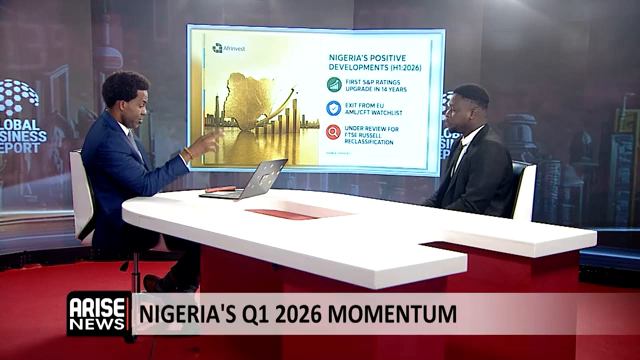
Afrinvest Research & Consulting Macroeconomic Strategist Segun Adams spoke to the Global Business Report about the firm’s Half-Year 2026 outlook on Nigeria’s Economy Subscribe to our Channel for high profile interviews. Follow us on Twitter at https://twitter.com/ARISEtv | and Instagram: https://www.instagram.com/arisenewsoffic

The following is a detailed overview of the contents from the Arise News interview titled "Nigeria’s Economy Is Gaining Momentum But Concerns Remain - Segun Adams" featuring a review of the Afrinvest H1 2026 macroeconomic review and H2 2026 outlook.

Global Market Performance & Commodities

In the first half of 2026, energy commodities outperformed other asset
Image for chunk 1

classes like fixed income and equities [00:55].

Asset Class Performance Index (Returns):

Plaintext

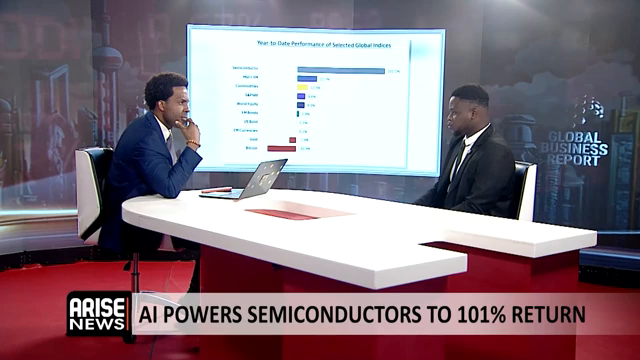
Semiconductors (AI Infrastructure): [========================================] 101%

MSCI Emerging Markets Index: [========] 22%

Commodities (Energy Led): [======] (Third Place)

Energy Rally: Global crude prices experienced a strong rally, remini

Image for chunk 2

scent of the 2022 Ukraine invasion spikes, crossing into the $120 per barrel range due to Middle East supply risks [02:02].

Impact on Nigeria: Nigeria's crude sold at a premium relative to Brent [02:36]. While domestic oil production averaged roughly 1.6 mbpd (below the targeted 1.84 mbpd), the increased market price ($80 average vs. the $65 budget benchmark)

Image for chunk 3

offset the output deficit, keeping revenue targets on track [02:49].

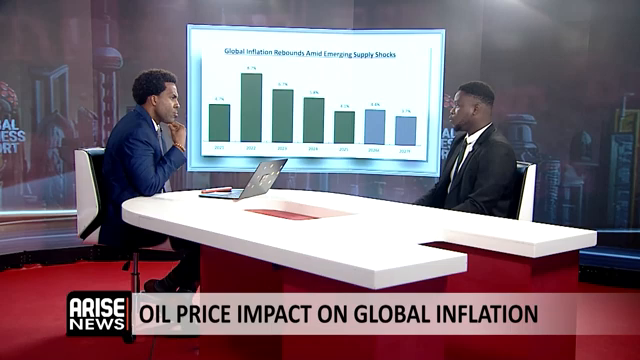
Global Inflation: Supply shocks kept global inflation elevated at an estimated 4.4%, breaking previous expectations of steady central bank easing [03:28].

The AI Infrastructure Super-Cycle

The global financial market reflects a transition from the internet age into the AI age [05:56].

Over

Image for chunk 4

$500 billion was earmarked for AI infrastructure investments by major technology companies in 2026 [06:24].

Top market performers shifted heavily toward deep value-chain infrastructure enablers like Micron, TSMC, and Nvidia, emphasizing memory technology, chip design, and equipment manufacturing [06:44].

Nigeria’s Macroeconomic Trajectory

The Nigerian economy

Image for chunk 5

displayed stronger structural indicators, prompting an upgrade in its credit environment [09:59].

Plaintext

+-------------------+---------------------------------------------------------+

| Indicator | H1 2026 Metrics & Observations |

+-------------------+---------------------------------------------------------+

| GDP Growth

Image for chunk 6

| Q1 GDP grew at 3.9%, supported by the oil sector (2.6%) |

| | and a resilient non-oil sector (3.9%) [00:09:08]. |

+-------------------+---------------------------------------------------------+

| Inflation | Headline inflation anchored near 15%, though monthly |

| | rates breached 2% due to high

Image for chunk 7

fuel prices [00:04:29]. |

+-------------------+---------------------------------------------------------+

| Reforms & Credit | Nigeria achieved its first S&P credit upgrade in over a |

| | decade and exited financial watchlists [00:09:52]. |

+-------------------+---------------------------------------------------------+

| Divergence

Image for chunk 8

| Capital-intensive sectors doubled in growth, whereas |

| | labor-intensive sectors matched population growth [00:10:38].|

+-------------------+---------------------------------------------------------+

Capital Inflows & Foreign Exchange Reserves

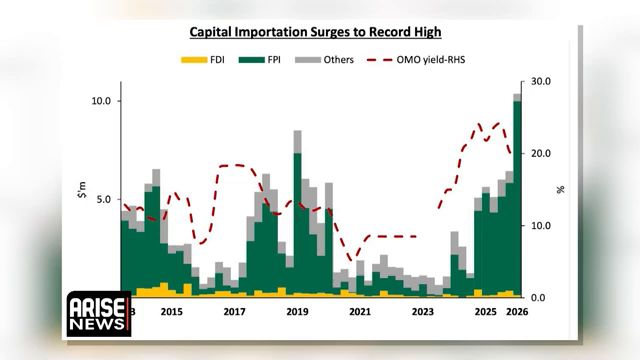
Nigeria achieved an influx of $10.7 billion in capital importation, though concerns r

Image for chunk 9

egarding its long-term composition persist [12:29].

Foreign Portfolio Investment (FPI): Accounted for roughly 95% of incoming capital, drawn in by high OMO (Open Market Operations) yields [12:34]. Economists warn that these "hot money" flows are highly mobile and susceptible to external global economic shocks [13:42].

Foreign Direct Investment (FDI): Remained

Image for chunk 10

low at just 1.3% of inflows, with 96% of that fraction concentrated strictly within the banking and finance sector rather than broader productive industries [14:21].

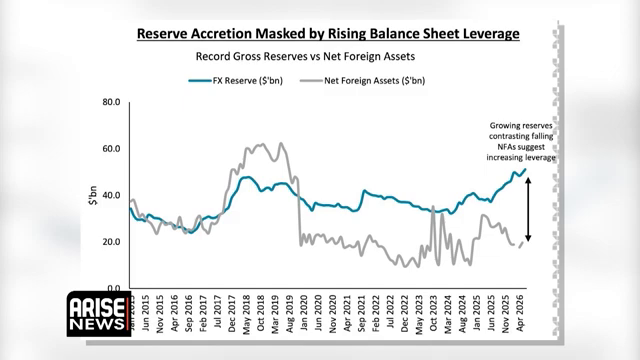
FX Reserves vs. Net Foreign Assets: Gross FX reserves built up comfortably to 2019 levels (offering 12 to 13 months of import cover) [15:11]. However, Net Foreign Assets (NFA) showed a downward

Image for chunk 11

trend line, indicating increased leverage and liabilities on the Central Bank of Nigeria's balance sheet [15:37].

Public Debt Framework

Nigeria's public debt sits at roughly 159 trillion Naira domestically alongside $110 billion in external obligations [17:54].

Plaintext

[Debt-to-GDP Sustainability Thresholds]

Actual Debt-to-GDP: [======

Image for chunk 12

=============] 36%

New Legal Ceiling: [=========================================] 60%

While the World Bank classifies Nigeria as a moderately indebted country compared to regional neighbors based on a 36% Debt-to-GDP ratio, the core challenges lie in debt utilization and servicing [17:17]. Debt-service-to-revenue ratios remain elevated near 60%, and s

Image for chunk 13

mall capital expenditure (capex) utilization suggests borrowing is not driving strong multiplier effects in productivity [18:48].

H2 2026 Outlook and Summary

Afrinvest updated its full-year projections, adjusting the average 2026 inflation expectation slightly upward to 15.8% to factor in disruptions from late Q1/early Q2 global commodity shifts [20:25]. Goin

Image for chunk 14

g toward 2027, the firm highlights that macroeconomic stabilization should not be the final goal. To replicate industrial transitions like Vietnam, Nigeria must systematically tackle internal insecurity—noted as a chief reform killer—and build structural continuity [20:49].

Nigeria’s Economy Is Gaining Momentum But Concerns Remain - Segun Adams

Arise News ·

Image for chunk 15

Viewer Discussion & Comments

@tobioluwasegun4042
SEGZ!