The Massive Machine at the Bottom of the Sea


Channel: Cleo Abram
Uploaded by Cleo Abram on 20260731
Categories: Science & Technology
Tags: cleo abram, cleo abrams, cloe abrams, cloe abram, big if true, huge if true, neutrino, nutrino, space, universe, science
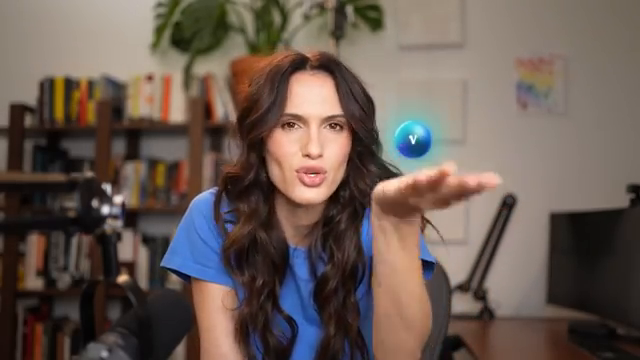
Off the coast of Sicily, there’s a massive underwater machine. It looks like a forest of floating spheres… And on the surface, hidden in an abandoned winery, a computer watches them and waits. And in 2023, they saw something… Something WAY smaller than an electron tore through that forest, setting off a signal nearly 30x more pow

Here is a detailed breakdown of the video content:

Introduction to Neutrino Astronomy and KM3NeT

The Mediterranean Experiment: Off the coast of Sicily, hundreds of spherical detectors are dropped into the ocean [00:00]. Once deployed, they unroll to create a massive forest of floating sensors [00:14].

The Abandoned Winery Lab: A computer sits hidden inside an old winery on the surface, waiting for signals from the deep-sea array [00:24].

The 2023 Discovery: In 2023, an ultra-powerful signal—roughly 30 times stronger than anything previously recorded—tore through the detector at near-light s
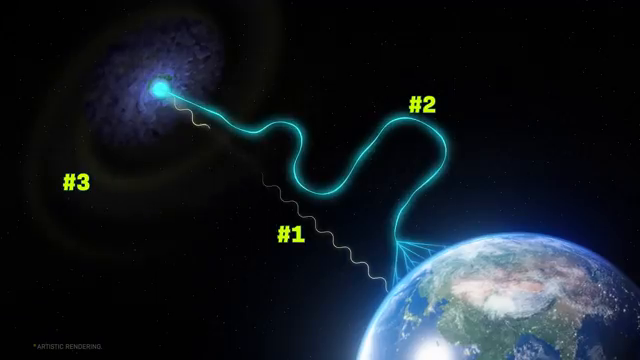
Image for chunk 1

peed [00:33]. While telescopes worldwide pointed toward the source in space, they found nothing, highlighting the ongoing mysteries scientists are trying to solve [00:52].

Global Collaboration: Alongside the Mediterranean-based KM3NeT, the IceCube detector buried deep within Antarctic ice utilizes over 5,000 similar spheres [01:05]. Together, these projects form a global initiative to observe extreme cosmic events [01:21].

What is a Neutrino?

Extreme Scale and Abundance: Neutrinos are fundamental particles that are vastly smaller than electrons [02:41]. Because they rarely interact with mat

Image for chunk 2

ter, roughly 100 trillion neutrinos pass through a human body every single second [03:02].

The "Ghost Particle": Their ability to pass straight through stars, planets, walls, and human bodies without obstruction is what makes them exceptionally powerful tools for astronomy [03:14].

The Four Ways We Study the Universe

Light (Photons): Includes everything from radio waves and visible light to gamma rays [03:38]. However, light gets easily blocked, reflected, and warped by dense cosmic matter [04:01].

Cosmic Rays: High-energy charged particles used to study deep space chemistry, though they ar

Image for chunk 3

e tossed around unpredictably by magnetic fields [03:45].

Gravitational Waves: Ripples in spacetime that signal massive events, but cannot pinpoint exact details or material composition [03:55].

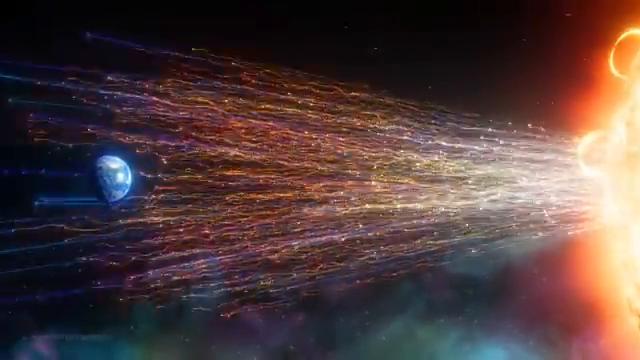
Neutrinos: The fourth option [04:22]. Because they carry no electrical charge and rarely collide with anything, they travel in straight lines from their source at nearly the speed of light [04:28]. Catching them provides a form of "X-ray vision" for the universe, allowing researchers to see directly inside stellar cores like supernovas [04:57].

How the Detectors Work

The Needle in a Haystack: Since

Image for chunk 4

neutrinos almost never interact with matter, catching one requires massive scale [06:07].

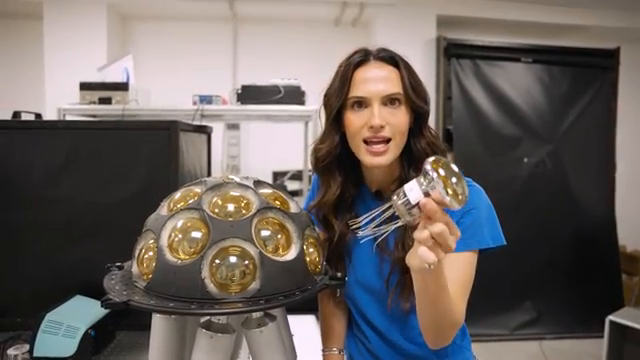
Building the DOMs (Digital Optical Modules): At a lab in Caserta, Italy, technicians hand-assemble spherical detectors destined for the Mediterranean Sea [06:27]. Each DOM is fitted with a mini-computer and 31 highly sensitive photomultiplier "eyes" capable of detecting a single photon [07:28].

Detecting the Invisible: Scientists cannot directly detect a neutrino [08:10]. Instead, they wait for the rare moment when a neutrino collides headfirst with a proton inside a water molecule [09:02].

The Cherenk

Image for chunk 5

ov Effect: The collision produces a heavier particle moving faster than the speed of light in water (though slower than the speed of light in a vacuum) [09:43]. This creates an optical equivalent of a sonic boom—a faint flash of blue Cherenkov light—which the optical sensors capture [10:04].

The Earth as a Lens: By focusing on particles that pass entirely through the Earth from the opposite side, the detectors use the entire planet as a giant lens [11:59].

Milestones in Neutrino Astronomy

2017 Breakthrough: IceCube detected a high-energy neutrino originating from a blazar (an active galaxy)

Image for chunk 6

4 billion light-years away, confirming the source of cosmic rays and heavy elements [13:06].

2022 Discovery: IceCube peered directly through the gas and dust of an active galaxy 50 million light-years away, looking inside a cosmic engine that traditional light-based telescopes could never penetrate [14:02].

The Future: With KM3NeT expanding toward its full capacity and joining forces with IceCube, neutrino astronomy continues to open an entirely new window onto the universe [14:53].

https://www.youtube.com/watch?v=GjDlPhwsdCs

The Massive Machine at the Bottom of the Sea

Cleo Abram · 698K v

No image available for chunk 7

Viewer Discussion & Comments

@thisuserisjustauser
Omg hiiii Cleo😭 I'm a Biotech student and I've watched everything on your page, I'm constantly learning new things from your channel and you're my top 3 people to watch on here, it makes me really happy seeing women in science and tech and I love you so much🥹❤️ you inspire me everyday and I hope to be as awesome as you one day!
@Vitus331
These videos just keep getting better and better. These animations were so good.
@StormTMad
best youtube recommendation i could've possibly gotten right now
@bobbyrobert5493
One of the few people to watch that is worth watching on YouTube
@NicholasbelievesinChrist
The joy of Cleo's curiosity is just beautiful. The first time I've ever felt a love for science.
@thejoyboy9513
This is the earliest ive been to a video
@Mikel-c1i
News headline:
@Vitus331
Im so proud of these scientists, not only for the experiments but mostly for 2 genuinely GOOD names. ICECUBE and KM3 are so catchy.
@rogerwertz
"On the surface, hidden inside an abandoned winery, a computer watches them and waits..." I love how Cleo's intros can sound so unhinged when taken out of context of the incredible science she's explaining. 😅
@MG-myth
"And they find...... Nothing!"
@goorlando1
shoutout to your production team! your visuals are always great at explaining this stuff
@alleyofwords
Your videos should be shown in schools. Imagine a student watching it and dreaming to be part of such mind boggling science experiments. Wow! The world is a better place
@JimBab-tsk
New forest discovered. ocean Ball forest
@HipGnosis491
Title song SLAPS. 1:44
@Parabellum-X
7:43 That...laugh... 😆