The Real Reason European Cars Can't Compete


Channel: Patrick Boyle
Uploaded by Patrick Boyle on 20260704
Categories: Education
Tags: finance, trading, patrick boyle, on finance, cfa exam, kings college london, business school, quantitative finance, financial derivatives, personal finance, investing, investments, stock market, corporate finance, volkswagen, china 2.0
Taking care of your health just got easier, thanks to my sponsor Zocdoc! Start here at: https://zocdoc.com/partickboyle Europe's automotive industry is facing a historic crisis as Volkswagen weighs unprecedented factory closures and massive job cuts. However, the root of the problem isn't just high energy costs or European bureauc

Here is a highly detailed breakdown of the content and core economic arguments presented in the video "The Real Reason European Cars Can't Compete".

1. The Financial and Operational Decline of European Automakers

European automotive giants are facing an unprecedented crisis, highlighted by severe stock drops, massive layoffs, and structural retreats:

Volkswagen: Its stock has plummeted over 65% over a five-year period, trading lower than it did during the 2015 "Dieselgate" emissions scandal [00:13]. To counter this, VW is considering breaking historical corporate taboos by elimina


Image for chunk 1

ting up to 100,000 jobs and closing four production factories in Germany [00:48].

BMW: The company is allocating up to 1 billion euros for restructuring, which market analysts estimate will result in 10,000 job cuts and a 15% reduction in European manufacturing output [02:07].

Mercedes-Benz: The manufacturer has deferred employee summer bonuses and requested that its workforce transition back to a 40-hour work week while only receiving pay for 35 hours [02:25].

Peugeot: Showcasing the loss of international market share, Peugeot managed to sell only 373 vehicles in Australia over a

Image for chunk 2

five-month span—fewer total units than luxury brand Ferrari [02:42].

2. Misdiagnosing the Crisis: Official Excuses vs. Statistical Realities

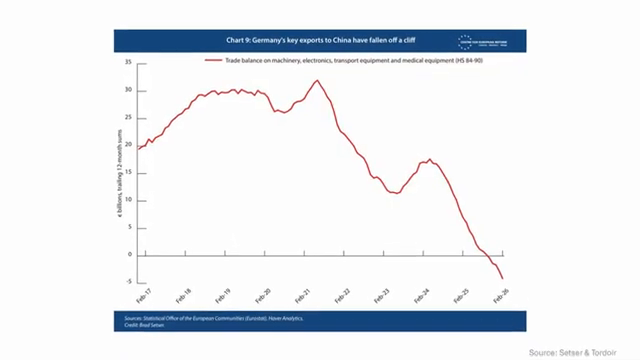
European officials often point to three internal scapegoats for the automotive industry's decline: high energy costs, an aging demographic workforce, and excessive bureaucracy stemming from Brussels [03:05]. However, the economic data tells a different story:

Germany's GDP Shortfall Contributors

+-----------------------------------+----------+

| Cause | Impact % |

+-----------------------------------+----------+

|

Image for chunk 3

Energy Shock | 40% |

| Lost Export Markets | 40% |

| Bureaucracy & Weak Local Demand | 20% |

+-----------------------------------+----------+

While the total cutoff of cheap Russian energy created a historic shock [03:42], neighboring nations like Denmark and the Netherlands operate under identical EU regulatory frameworks yet maintain economic growth [04:30]. The primary driver is a dramatic shift in global trade dynamics: the European Union now runs a massive trade deficit with China, losing roughly 1 billion euros every singl

Image for chunk 4

e day [05:05].

3. Product Development Dynamics: "China Speed"

A primary reason Western automakers are falling behind is the vast difference in product development timelines, a metric referred to as "China Speed" [07:44]:

Development & Operational Comparisons

+-----------------------+--------------------------+--------------------------+

| Feature | European / US Companies | Chinese Companies |

+-----------------------+--------------------------+--------------------------+

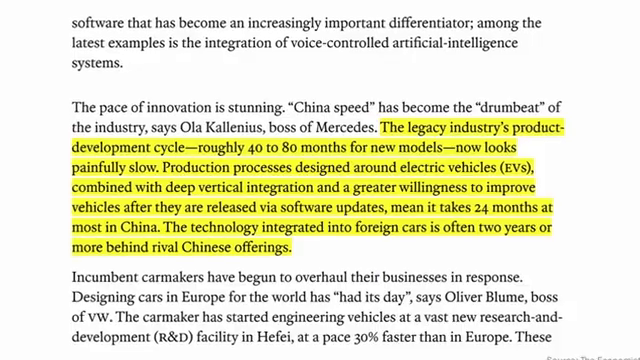
| Development Cycle | 40 to 80 months | Under 24 months |

| Manage

Image for chunk 5

ment Hierarchy | Traditional, rigid | Flat, rapid execution |

| Quality Control Focus | Exhaustive pre-release | Post-release OTA updates |

+-----------------------+--------------------------+--------------------------+

Chinese firms achieve these rapid turnaround times through grueling work hours, flat corporate structures, and an agile software-first philosophy [08:01]. They prioritize launching vehicles quickly and resolving unexpected mechanical or software bugs post-purchase via Over-The-Air (OTA) system updates [08:10].

4. Macroeconomic Shifting: China Shock 1.0

Image for chunk 6

vs. China Shock 2.0

The automotive crisis is part of a broader macroeconomic event termed "China Shock 2.0" [08:42]:

China Shock 1.0 (Post-2001): Following China's entry into the World Trade Organization, its exports primarily replaced low-wage, low-tech global manufacturing sectors like textiles, toys, and basic electronics [08:52]. Germany avoided damage during this era because China's rapid industrialization required importing vast amounts of premium German machinery and vehicles [09:20].

China Shock 2.0 (Present): China now represents approximately 18% of global GDP [09:39]. I

Image for chunk 7

ts export growth has moved straight into highly complex, capital-intensive technological sectors. Rather than importing factory tools, China has become a net exporter of capital goods to Germany [10:07].

5. The Math Behind the Cost Disadvantage

European cost-cutting measures are structurally insufficient to close the competitive pricing gap with Chinese imports:

The European Layoff Math: Firing 100,000 VW workers saves roughly 7 billion euros in wages, and shutting down plants shaves off another 3 billion euros [13:23]. Across VW's 9 million annual vehicle sales, this historic dow

Image for chunk 8

nsizing saves only about 1,000 euros per vehicle [13:41].

The Chinese Cost Advantage: According to McKinsey data, Chinese electric vehicle (EV) manufacturers possess a 20% to 50% manufacturing cost advantage over Europe [14:05]. On a standard 30,000-euro vehicle, Chinese firms hold a baseline structural savings advantage of 6,000 euros per car [14:14].

6. Regulatory Pressure and Tech Dominance

European auto manufacturers cannot simply scale back EV production to protect profit margins due to strict environmental mandates:

The Compliance Trap: Brussels enforces rigid fleet emission

Image for chunk 9

targets; failing to meet designated EV sales quotas results in severe financial penalties [15:23].

The Fuel Factor: European gasoline prices are nearly 70% higher than in the United States, forcing local consumers to look toward electric powertrains [15:43].

The Technology Gap: Consumers are actively selecting Chinese models over domestic options because of significant technological superiority. For instance, BYD’s Denza models feature advanced voice-controlled AI systems and dual-gun charging capabilities that allow a 0% to 70% battery replenishment in just 5 minutes [16:35]. By

Image for chunk 10

comparison, equivalent European EVs require up to 40 minutes at a charging station [16:42].

7. Exploiting Regulatory Loopholes

To protect domestic manufacturing, the EU introduced the Industrial Accelerator Act, attempting to tie government EV buyer subsidies directly to local content and regional assembly requirements [17:01]. Chinese firms quickly bypassed this barrier by leasing or buying up idle manufacturing plants abandoned by struggling Western brands [17:21]:

Chinese Infiltration of European Auto Plants

+-----------------------+--------------------------+-----------------

Image for chunk 11

---------+

| Chinese Brand | Abandoned European Facility |

+-----------------------+--------------------------+--------------------------+

| Chery | Former Nissan Plant (Barcelona, Spain) |

| Geely | Idle Factory Hall (Valencia, Spain) |

| BYD | VW's Transparent Factory (Dresden, Germany) |

| Leapmotor / Dongfeng | Stellantis Joint Production Lines (Rennes, France) |

+-----------------------+--------------------------+--------------------------+

By completing fi

Image for chunk 12

nal vehicle assembly within these local facilities, Chinese vehicles officially qualify for European taxpayer-funded subsidies, accelerating the loss of regional technological expertise [17:47].

8. The Future of Global Trade Policy

As traditional trade frameworks fracture, European leaders are debating how to safeguard what remains of their industrial foundations:

The Leaky Bucket Issue: Standard product-specific tariffs are too slow to deploy. When the EU placed trade duties specifically onto Chinese battery electric cars, Chinese exporters immediately shifted strategies, causing

Image for chunk 13

a 155% overnight surge in hybrid vehicle exports to Europe [21:47].

Proposed Tariff Remedies: France has floated a blanket 30% tariff on all incoming Chinese imports [22:23]. However, this comprehensive approach risks mirroring the historic Smoot-Hawley Tariff Act of 1930, which triggered immediate global trade retaliation and worsened the Great Depression [22:48].

The Modern Trade Outlook: Trade experts suggest shifting toward an economy-wide regulatory tool similar to America's Section 301 law [23:44]. This allows a government to investigate broad systemic distortions—such as c

Image for chunk 14

urrency undervaluation—and target strategic tech sectors flexibly rather than suing over individual components [23:54].

Ultimately, the global economy is moving away from a 30-year era of prioritizing supply-chain efficiency above all else [25:28]. Geopolitical friction is forcing a shift toward self-sufficiency and supply redundancy, ushering in a market landscape defined by higher retail prices for consumers and tighter margins for businesses [26:13].

Associated URL: https://www.youtube.com/watch?v=Q0rBGfn-LyU

The Real Reason European Cars Can't Compete

Patrick Boyle · 946K view

Image for chunk 15

Viewer Discussion & Comments

@PBoyle
Taking care of your health just got easier, thanks to my sponsor Zocdoc! Start here at: http://zocdoc.com/patrickboyle
@tomholroyd7519
Don't fix the problem! Put a tarp over it and make it illegal to look underneath!
@comfortlee1418
You know its bad when Patrick Boyle talks about it
@jhwheuer
Reminds me of the USA in the 80s encountering Japan
@happyundertaker6255
German here. German Automakers have priced themselves out of their market. The average German worker can’t afford new German cars, as salaries have stagnated for decades.