What Climate Science Actually Says vs. What You've Been Told It Says


Channel: Alliance for Responsible Citizenship
Uploaded by Alliance for Responsible Citizenship on 20260710
Categories: Education
Tags: ARC Forum, ARK, ARK FORUM, Jordan Petereson, ARC Conference, ARK Conference, London, Speakers, Speeches, Talks, ARCC, Conference
What does climate science actually say—and where does it differ from the public narrative? In this talk, physicist Steve Koonin draws on his experience as a Caltech professor, former BP Chief Scientist, and former U.S. Undersecretary for Science to examine climate models, IPCC reports, energy policy, and the gap between scientific

Video Title: What Climate Science Actually Says vs. What You've Been Told It Says

Channel: Alliance for Responsible Citizenship

The video features a presentation by a scientist with 50 years of experience (including roles at Caltech, BP, and the US Department of Energy) discussing th
Image for chunk 1

e significant gap between actual climate science (as documented by the IPCC) and the alarming narratives presented in public and political discourse.

Key Insights and Historical Data [01:34]

The speaker establishes that while global temperatures have risen by approximately 1.3°C sinc

Image for chunk 2

e 1900 and human activity has contributed to this warming, humanity has simultaneously flourished:

The global population quintupled.

The global economy expanded roughly 25-fold.

Life expectancy increased by 50 years.

Deaths caused by extreme weather events (hurricanes, floods, drough

Image for chunk 3

ts, extreme heat) plummeted by about 95%.

In the UK specifically, cold-related deaths outnumber heat-related deaths by more than 20 to 1 [03:38].

Climate Models and Future Projections [03:56]

The speaker highlights major uncertainties and flaws in current climate projections:

Model S

Image for chunk 4

ensitivity: Current IPCC models show a climate sensitivity to carbon dioxide ranging from 1.8°C to 5.6°C (a factor of three), indicating a lack of precise understanding [04:13]. Models projecting the highest warming run "too hot" compared to actual historical observations and have be

Image for chunk 5

en quietly de-weighted [05:01].

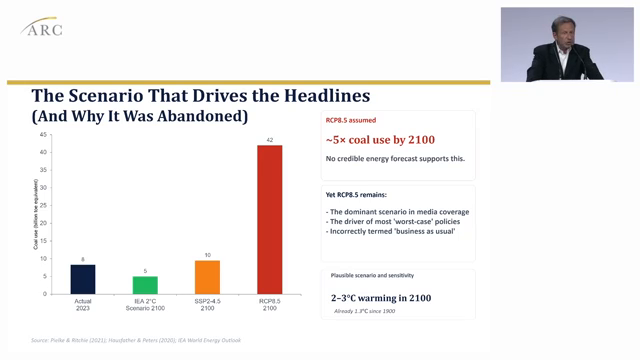
Exaggerated Scenarios: The most alarming headlines rely on a scenario called RCP 8.5, which unrealistically assumes global coal use will quintuple by 2100 [05:28].

When correcting for models that match actual observations and using plausible energy tra

Image for chunk 6

jectories, the projected warming by 2100 is between 2°C and 3°C, with a median of 2.2°C—a challenge that warrants serious attention but does not represent an apocalypse [06:06].

Economic Impact [06:49]

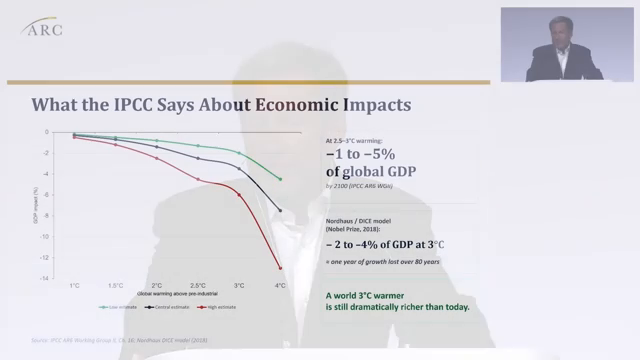
According to the IPCC's Working Group II report, a warming of 2.5°C to 3°C is esti

Image for chunk 7

mated to reduce global GDP by only 1% to 5% over the next 80 years. This is equivalent to losing just one or two years of economic growth in a world that will otherwise be dramatically richer.

The Three-Stage Compression of Information [07:58]

The information pipeline systematically

Image for chunk 8

strips away caveats and exaggerates alarm through three distinct phases:

[ Full Scientific Report ] -> Thousands of pages with ranges, caveats, and uncertainties.

[ Summary for Policymakers ] -> Shorter, line-by-line political negotiation; minimizes uncertai

Image for chunk 9

nty.

[ Media & Political Comms ] -> Caveats disappear entirely; uncertainty is replaced by false confidence.

Real-World Costs of Misrepresentation [09:07]

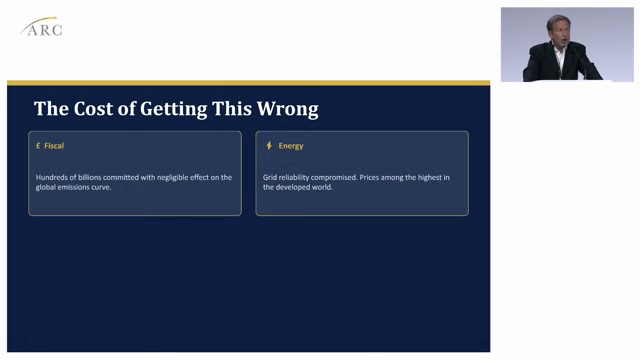
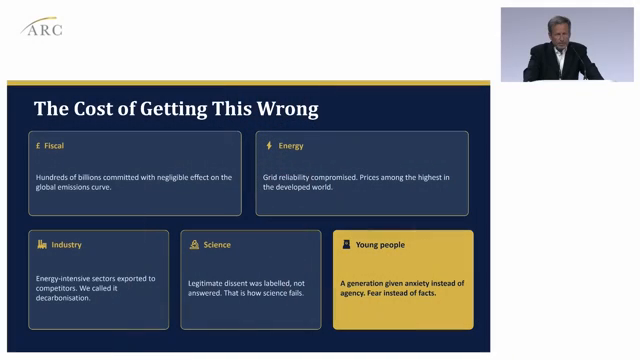
Fiscal & Energy Costs: Billions are spent on energy transitions restricted by the laws of physics and e

Image for chunk 10

conomics, resulting in negligible impacts on global emissions. Meanwhile, the UK faces the highest electricity prices in the developed world, handicapping its industries against Asian and North American competitors.

Damage to Science: Legitimate academic dissent regarding model relia

Image for chunk 11

bility or scenario plausibility is dismissed, and researchers are labeled "deniers" as a career weapon rather than being engaged honestly [11:18].

Psychological Impact on Youth: An entire generation has been taught to view the future with dread and anxiety, facing an alleged "existen

Image for chunk 12

tial threat" that is not supported by actual IPCC data [11:53].

Conclusion [12:45]

The presentation concludes with a call for clear thinking and a mindset shift based on truth, noting that environmental stewardship does not conflict with abundant, reliable, and affordable energy. In

Image for chunk 13

fact, economic wealth and innovation are required to build the infrastructure needed to adapt to whatever climate future arrives.

URL: https://www.youtube.com/watch?v=nl__O_QGIR4

What Climate Science Actually Says vs. What You've Been Told It Says

Alliance for Responsible Citizenship

Image for chunk 14

Viewer Discussion & Comments

@ARockRaider
the second he mentioned cold deaths in Europe outnumbering heat deaths i instantly thought about how it seems every Globalist in power is restricting AC and power use during a heatwave. (only for the little people of course, government atriums and high level staff continue to enjoy heavy air-conditioning)
@arthurdixon5890
The British government should be made to watch this excellent video.
@katherinekelly6432
Fear is a good motivator. That is why parents and institutions use it but it does not necessarily produce healthy reactions to a crisis.
@silvio2164
The problem is society just believes and never questions.
@Huub1e
There’s a mountain between nothing at all is happening and we’re all gonna die if we don’t hand our allegiance to politicians. Being somewhere on that spectrum isn’t denial. It’s being reasonable.